Nike’s Scale and NWSL Boot Deals
The Economist and The Athletic are two digital publications I try to read daily. Each week, I'll share two articles that caught my attention; one from each publication.
This week: Nike’s revenue decline and NWSL rules on boot deals.
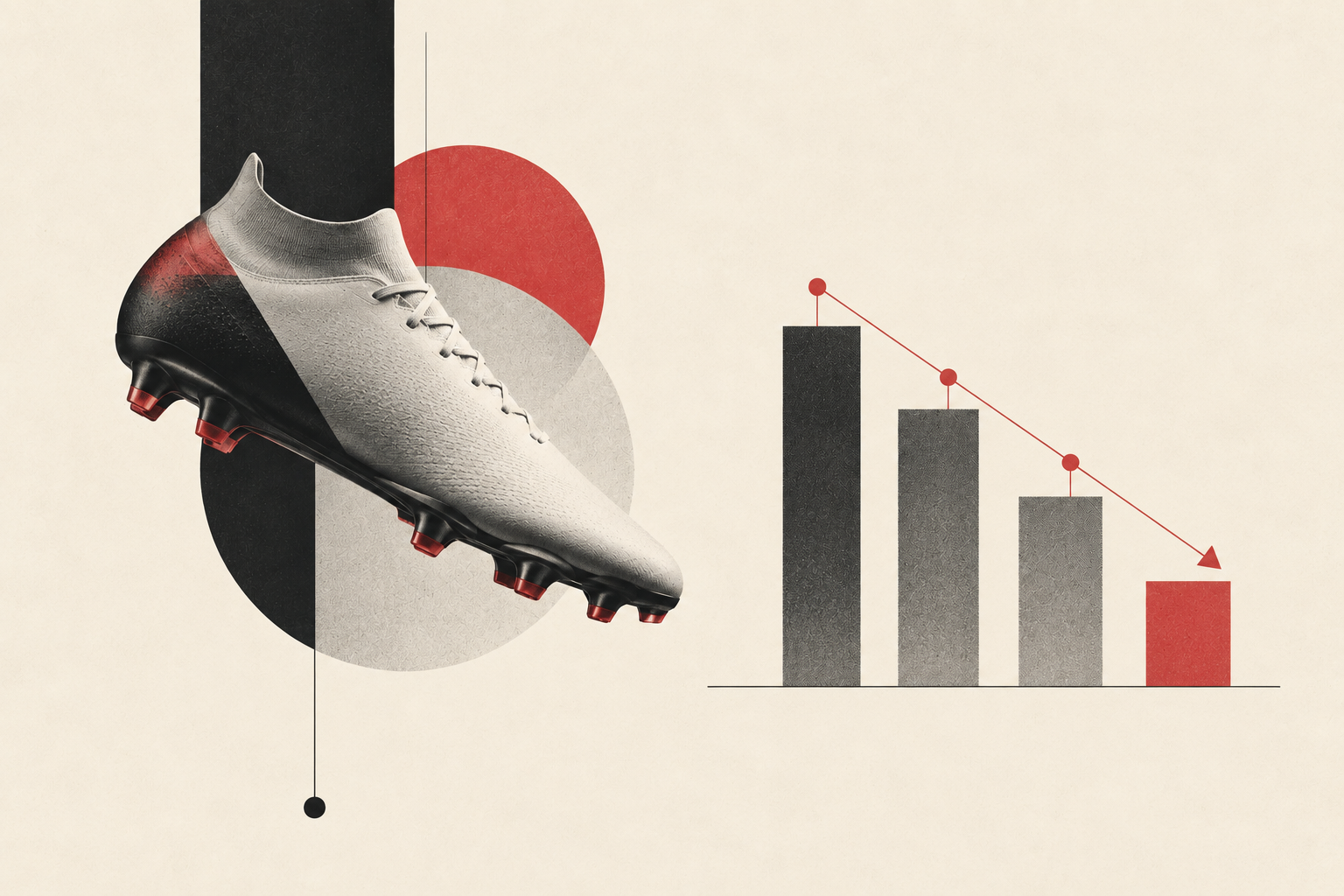
Nike can’t just do it any more
With the recent news of Nike’s twelve year low $38 share price down from $177 in November 2021, it reminded me of this Economist long read back in June 2026. The piece highlighted various economic, cultural and competitive challenges that have faced the Nike leadership over the last few years. There were a few themes that interested me:
1. The Scale: Whilst Nike sells more trainers than anyone and had $46.3bn of revenue in FY2025, the piece talks of lost cultural momentum and that has recently resulted in seven quarters of declining income. Although Adidas and New Balance are deemed retail competitors, “when it comes to scale, Nike’s peers are… Starbucks and General Motors”. Nike remains the footwear outlier but there are new, cooler kids on the block.
2. Previous Nike boss John Donahoe oversaw a Nike strategy of removing Nike supply and distribution to most third party retailers (in the UK, Sports Direct, JD Sports and some others remained the chosen few). Whilst this worked because of Nike’s renewed focus on its direct to consumer web and own shop offering during the pandemic, once restrictions were lifted and people went back to shops, they limited their brand catchment. Indeed, the piece explains that in Nike’s place, came challenger brands like On and Hoka who filled the shelf space Nike had vacated.
3. The Celebrity Playbook: The tried and tested Nike formula has previously worked so well with iconic global names like Jordan, Woods, Williams and Agassi. Chose "an athlete or celebrity on their way up; create inspirational advertising about the star’s grit and rebellious personality; and let the cash roll in.” But “the art of celebrity-wrangling has changed since Nike wrote the modern playbook back in the 1980s. In our increasingly fractured culture, every superstar will alienate at least some consumers”. Nike athlete Colin Kaepernick, after kneeling during the US national anthem appeared to be the lightning rod that divided America and led to further internal Nike division on the right strategic and cultural path to take. "We’re taking this entire year to not have any kind of opinion on any kind of social issue,” one Nike executive was recently quoted as saying.
4. The New Ex-Nike Challenger: Whilst many know that Roger Federer was an ex-Nike athlete, I didn’t know that challenger brand On Running’s (On) founder Olivier Bernhard was turned down by Nike after designing a new type of running shoe. So, he started his own company in 2010 and with parallels of Nike signing up Michael Jordan to a revenue share deal, On offered Roger an endorsement plus deal with 3% of the company included (currently valued at over $300m). A company founded by a Nike reject, endorsing a Nike defector in Federer, and growing at 34% year on year. Whilst nowhere near as big ($4bn in sales last year), On is another example of the heightened challenger competition in the market.
Whilst Nike was once the plucky underdog (expertly told by founder Phil Knight in his excellent Shoe Dog book), the Economist piece questions whether Nike's scale has now become its constraint.
Player fines continue under NWSL’s footwear sponsorship policy as union files grievance
It was reported in June that the NWSL had adopted a footwear sponsorship policy. It has the consequence that if players are wearing non-Nike boots (the league’s sponsor), and any other footwear brands had not paid the NWSL $100k per season and a minimum of $5k per player, then the players would be fined for wearing unauthorised brands. Players would therefore have to tape up/cover up their boots to avoid being in breach of league rules. The difficulty is that some boot deals will contain clauses that precisely prohibit their boots being covered up. Some players have already been fined by the league for non-compliance. New Balance have taken a novel approach alongside their player Michelle Cooper which has garnered significant publicity and have paid for Cooper’s fines as a result. Indeed, the NWSL Players Association has recently filed a dispute with the league arguing among other things that the policy conflicts with the league’s CBA.
The rationale appears to be that brands other than Nike should have to pay the league for the right to have their players' boots visible whilst meeting the minimum payment obligations towards the players. It was reported that Adidas and Puma have signed up to such a deal with the NWSL but other brands like New Balance, Lotto, Caddix, IDA and Skechers remain in negotiations with the league.
Whilst it is common practice in other US sports leagues including the NFL, NBA, WNBA, MLB and MLS, nothing of the sort has occurred in Europe as yet. It would be akin to the Premier League or the WSL requiring Adidas to pay a set amount for showcasing the three stripes on a contracted player’s boots.
The NWSL policy exposes a core NIL/image rights tension: whether league-level sponsorship rights should override individual players' boot deals and their contractual obligations to competing brands. Nothing comparable exists in European football, where boot sponsorship remains firmly a matter for the individual player, and any attempt to impose a similar model in the Premier League or WSL would likely face resistance from players, agents and brands.